
Imagine the scene: you have barely set foot on the tarmac in Madagascar in December, feeling carefree and eager to swap your winter jacket for a swimsuit and relax under a radiant sun. Instead, the doors open onto a wall of torrential rain. A few hours later, you find yourself stranded in the middle of a tropical storm, facing a dirt track transformed into a river of red mud and national roads turned into flooded torrents. The result? Your dream road trip becomes an endless wait in a hotel, far from everything. Quite an unpleasant surprise.
This is the classic mistake made by travellers who plan their trip simply around the idea that “it is warm” at the end of the year, without considering the complex geographical and climatic realities of the Big Island. In Madagascar, the climate cannot be reduced to uniform tropical weather.
However, rest assured: there is no bad season in Madagascar. There are simply periods that may not be suitable for a specific travel plan. The key lies in planning ahead. Whether you dream of observing lemurs, travelling the tracks of the Deep South by 4×4 or relaxing on paradise beaches, this expert guide will give you all the practical insights you need to determine the best time to visit Madagascar and precisely plan when to travel to Madagascar according to your interests.
I-Understanding the climate in Madagascar
To plan your stay effectively and avoid unpleasant surprises, you need to understand how the climate in Madagascar works. Although the sun shines generously across the Big Island, its vast territory is home to a multitude of microclimates shaped by inland relief and contrasting maritime influences.
1.1 One island, two seasons, dozens of microclimates
The year can broadly be divided into two main periods: the dry season (from April to October) and the rainy season in Madagascar (from November to March). However, the reality on the ground is more complex due to the mountain range that runs through the island from north to south.
Did you know? The foehn effect is a weather phenomenon that occurs when wind encounters a mountain: on one side, the air rises, cools and causes rainfall. On the other side, the air descends after losing its moisture, becoming a very dry wind that is much warmer than it was initially.
These highlands act as a genuine climatic barrier:
- The East Coast: is directly exposed to humid trade winds from the Indian Ocean, resulting in rainfall throughout the year.
- The West Coast: protected by the relief, it enjoys a much drier and sunnier climate.
- The tropical North and arid South: the North experiences heavy heat and a pronounced wet season, while the Deep South has a semi-desert climate where rainfall remains extremely rare, creating significant seasonal differences from one region to another.
1.2 The rainy season in Madagascar: reality or misconception?
The wet season often scares potential travellers. In reality, the rainy season in Madagascar usually takes the form of intense but short showers in the late afternoon, giving way to beautiful sunny spells during the rest of the day.
The real point of concern is the risk of cyclones. The cyclone season runs from November to April, with a clear peak between January and March, mainly affecting the eastern and northern coasts. During these months, however, the Central Highlands and southern parts of the island remain relatively accessible and sheltered from major weather events.
From the field: the rainy season does not close Madagascar; it closes certain tracks.
II. Travelling to Madagascar month by month: the real traveller’s calendar
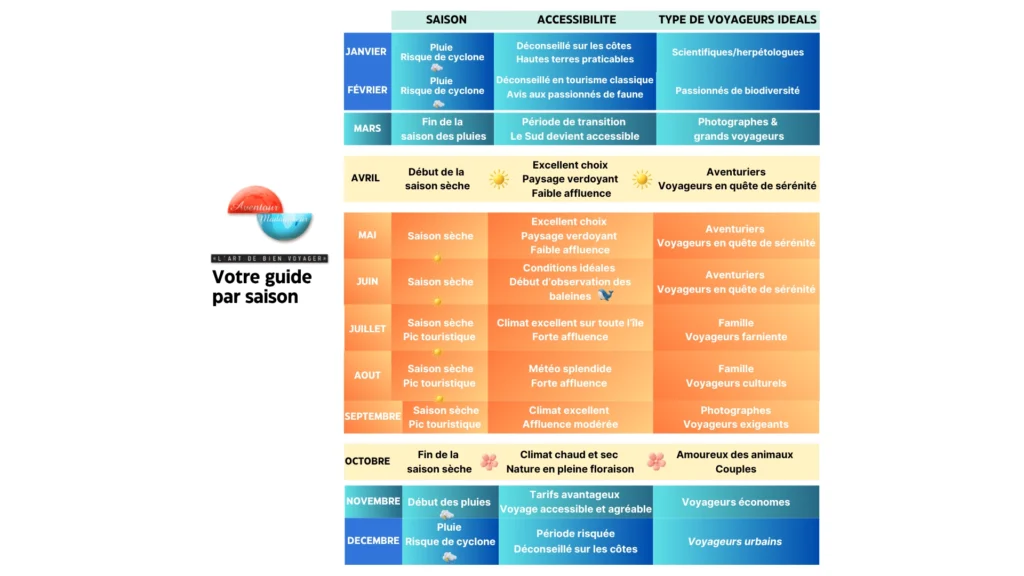
To give you an at-a-glance overview while preparing your trip, here is a summary table of travelling to Madagascar month by month, detailing accessibility and conditions during each period:
III. What is the climate like in the region you are visiting?
Travelling means being in the right place at the precise moment when the magic happens. Much more than a simple weather forecast, discover the secret calendar of each region to enjoy an exclusive experience.
The North (Nosy Be, Diego Suarez, Amber Mountain)
Northern Madagascar experiences a strong tropical influence. The best season in Nosy Be and its neighbouring archipelagos runs from May to November. During this period, the sea is exceptionally calm, offering optimal visibility for scuba diving and snorkelling.
Travel advice: for a successful stay, avoid January and February. Rainfall can be extremely heavy and the risk of cyclones is at its highest, seriously affecting maritime connections and sea excursions.
The Highlands (Antananarivo, Antsirabe, Fianarantsoa)
The central regions benefit from a climate moderated by altitude. They remain accessible throughout the year because the road infrastructure is generally better maintained than elsewhere. However, be aware that the austral winter (June to August) can be surprisingly cold: night-time temperatures frequently fall below 10 °C.
Travel advice: choose April-May and September-October to enjoy beautiful light, lush greenery and mild temperatures.
The East Coast (Sainte-Marie Island, Masoala, Toamasina)
This coastal region is the wettest in the country, experiencing intermittent rainfall virtually all year round. Paradoxically, July and August can be very rainy and windy despite the general dry season. The real ideal window is September and October: the winds die down, the sea becomes calmer and conditions are perfect for exploring the Masoala rainforest or enjoying the Whale Festival on Sainte-Marie Island.
Travel advice: want to make the most of Sainte-Marie? Avoid the cyclone season (January to April)! With the risk of flight cancellations and rough seas, it is better to postpone your stay and enjoy the experience to the fullest.
The South and arid Deep South (Isalo, Ifaty, Toliara, Fort-Dauphin)
The climate in southern Madagascar is characterised by almost permanent dryness and abundant sunshine. From November to March, the heat is intense, regularly approaching 40°C in the shade. The most favourable period runs from May to September: the air is more comfortable and the fine-sand tracks remain perfectly accessible.
Travel advice: special mention goes to Isalo National Park in July and August, when it offers some of the clearest and most star-filled night skies in Madagascar.
The West Coast (Morondava, Tsingy de Bemaraha, Avenue of the Baobabs)
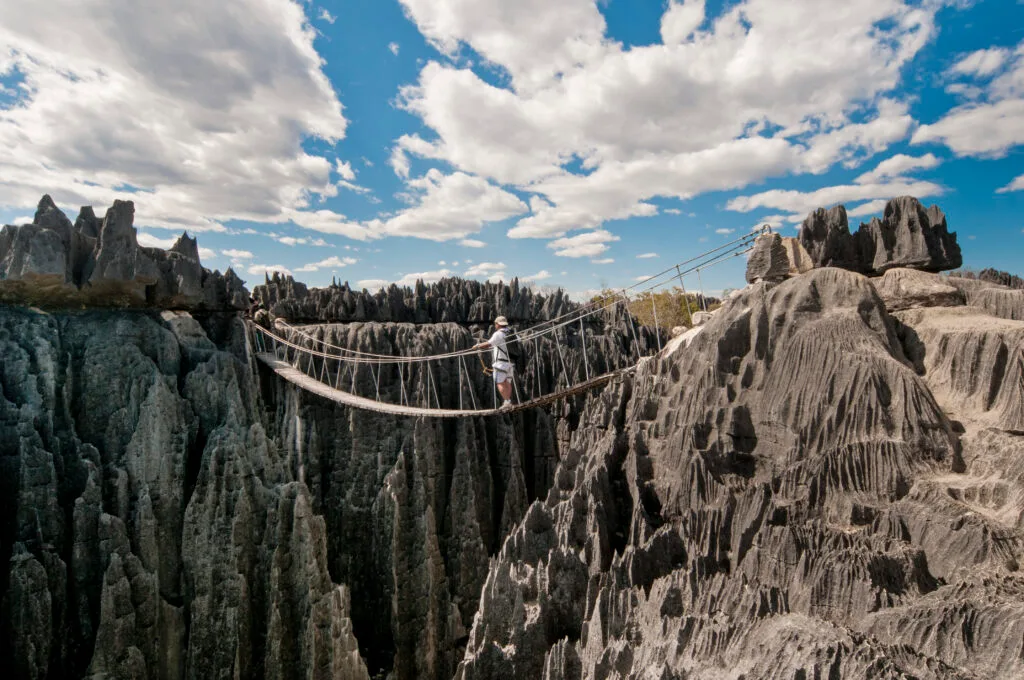
The west coast of Madagascar experiences extremely distinct seasons. The region is strictly inaccessible from January to March: rivers overflow and completely cut off the tracks leading to the famous Tsingy de Bemaraha, which also closes its doors to the public during this period. The Avenue of the Baobabs, meanwhile, offers two radically different faces: majestic at sunset beneath a clear sky during the dry season, it becomes spectacular at the beginning of the wet season when the giant trees are reflected in the large pools of water surrounding them.
Travel advice: do not attempt the journey without a 4×4 vehicle and preferably travel between May and October to ensure access to all the region’s sites.
What the climate really does to the roads
This is a logistical reality that most traditional travel guides tend to overlook: in Madagascar, the condition of transport infrastructure depends entirely on the weather on any given day. In this article, we reveal the realities behind Madagascar’s climate and its direct impact on the roads, to help you plan your trip with peace of mind.
Less than 10% of the country’s roads are paved. The rest of the network consists of dirt or laterite tracks. As soon as the rainy season sets in, these routes can quickly turn into deep ruts or rivers of mud that are impossible to navigate.
- RN7 (Antananarivo – Toliara): completely paved, it is the country’s main road and remains perfectly passable 12 months a year, regardless of the whims of the weather.
- RN5 (East Coast) or the Tsingy track (West): these routes are systematically cut off for 3 to 4 months each year, as makeshift bridges or ferries used to cross rivers become unusable.
Under these conditions, even a robust 4×4 vehicle is not enough: when the water level rises above wheel height, progress comes to a halt. For your planning, this means two golden rules if you travel during an intermediate or wet period: always allow one to two buffer days in your itinerary before your international return flight, and do not hesitate to favour domestic flights to move from one region to another without difficulty. Before every departure from a town or city, always take the time to check recent conditions with local drivers or your travel agency.
A word from our guide:
What type of traveller are you? The right season in Madagascar for your profile
Because a successful trip depends as much on the destination as on the ideal time to experience it, we have analysed five traveller profiles. So, are you more into tropical relaxation, cultural immersion or an off-the-beaten-track adventure?
Discover your profile and the perfect season to pack your bags!
5.1- The nature and wildlife traveller
For lovers of untouched nature, the climate in Madagascar sets the pace of the adventure. Adapt your trip according to your wildlife priorities: observe baby lemurs between October and January, choose March-April or November to see reptiles and amphibians at their most colourful, and aim for the July to September window to see when to watch whales in Madagascar.
5.2 The beach and relaxation traveller
If your absolute priority is swimming, white sand and sea excursions, without hesitation choose the period from May to October, focusing on the northern coast (Nosy Be) or the West (Anakao, Ifaty). Avoid the coastal areas from January to March at all costs, otherwise you may end up spending your holiday confined to your bungalow because of strong winds and cyclone-driven swells.
5.3 The hiker and adventurer
For major treks, such as crossing the Tsaratanana massif, exploring the eastern forest corridor or undertaking challenging hikes in Marojejy National Park, the dry season is an absolute necessity. Plan your stay between May and September to ensure stable trails, a lower risk of slipping and cool but manageable night-time temperatures when camping.
Discover the best hiking routes in Madagascar on www.alltrails.com/fr/madagascar.
5.4 The budget-conscious / crowd-avoiding traveller
If you are looking for peace and quiet while also wanting to optimise your budget, consider the “low season”, namely April-May and October-November.
Airfare and accommodation prices are often more affordable during these periods, availability is excellent, and local guides are much more receptive and available to show you their secret spots.
5.5 The cultural & Highlands traveller
Are you passionate about cultural adventure? Madagascar can also be discovered through its unique traditions. The Highlands are accessible all year round for this type of experience.
One point to note: the austral winter period (July to September) corresponds to the season of famadihana (the turning of the dead), a major traditional funerary ceremony. If you feel uncomfortable with these practices of communion with ancestors, avoid Highland villages during these months. If, on the other hand, you are looking for an authentic and respectful anthropological immersion, this is a rare opportunity worth considering.
VI When to see whales in Madagascar?
It is one of the most breathtaking natural spectacles on the planet. Every year, hundreds of humpback whales leave the icy waters of Antarctica and head towards the warm, sheltered waters of Madagascar to mate and give birth.
Sainte-Marie Island is recognised as the world’s leading destination for whale watching in Madagascar. The observation season runs from July to September. The real peak of activity occurs between mid-July and the end of August: this is the “nursery” period, when mothers can be observed close to boats teaching their young calves how to breach.
Did you know? In addition to Sainte-Marie, there are other major whale-watching locations in Madagascar:
- Antongil Bay (Masoala) : located directly opposite Sainte-Marie, this bay is a vast calving sanctuary, much wilder and significantly less frequented by tourist operators.
- Nosy Be : later in the season (from September to November), the Mozambique Channel also welcomes migrating humpback whales, as well as whale sharks and majestic manta rays.
Expert advice: During July and August, the sea can become particularly rough and choppy along the east coast due to the trade winds. If you are prone to seasickness, make sure you are properly equipped before boarding whale-watching boats. Finally, as part of sustainable tourism, make sure to carefully choose committed operators who follow the local responsible whale-watching charter (maintaining a minimum safety distance of 50 metres, approaching slowly from three-quarters behind and switching off engines when the animal shows signs of stress).
VII. Travelling to Madagascar in harmony with the seasons
Adopting a responsible approach to travel also means knowing how to intelligently adapt to the natural rhythms of the destination you are visiting. In this article, we explain how to put this approach into practice.
High season: protecting fragile ecosystems
The concentration of tourist flows in the same locations during July and August creates very strong localised environmental pressure on fragile ecosystems (freshwater consumption in dry areas, waste management by hotels, trampling of trails). By deliberately choosing to travel during the shoulder season (April, May, September or October), you directly help spread the environmental impact across national parks.
Rainy season: maintaining local employment and supporting the survival of ecolodges
Regardless of the season in Madagascar, guides, canoeists, artisans and ecolodge employees depend entirely on the tourism economy. By extending the activity season, you help them secure regular income throughout the year rather than facing significant financial insecurity during the quieter months. During the rainy season, your presence — even if only occasional — helps maintain local employment in community-run accommodation. Travelling in harmony with the seasons means accepting that your own rhythm should follow that of the Big Island, rather than expecting in January what only the dry season in July can provide. It is also important to find out about the breeding periods of species before planning an activity.
So, are you ready to plan your trip without unpleasant surprises?
You now have all the practical insights you need to determine precisely the ideal time for your travel project. As you will have understood, there is no universal magic formula: the right time depends above all on what you want to experience at the heart of Madagascar’s landscapes.
Madagascar is like nowhere else. Tell us what attracts you: unique wildlife, dream beaches, adventure tracks in the Deep South — and together we will build a tailor-made itinerary that respects your wishes and the authentic rhythms of the island.
Ask us for a personalised itinerary adapted to your pace.